Try This - Reading and understanding
The following extract is from The Open University course A103 An introduction to the humanities. (The course material here refers to the 1960s.)
Please read the text and comments in the suggested answers 1 to 6, listed below. Select the answers you feel are most accurate in relation to the text. Affluence came to America during the Second World War, and (though there were still many pockets of severe poverty) continued thereafter; economic recovery began in Europe from 1948 onwards.
Slowly the economic basis was established for the production, consumption and international exchange of new consumer goods. Between the mid-fifties and the mid-sixties there was a great increase in the number of multinational companies. New purchasers appeared in the market place: particularly young married couples, the working class in general, racial and ethnic minorities, those in the regions and provinces asserting themselves for the first time against metropolitan dominance, and women and girls.
Economic change combined with demography, specifically the ‘baby boom’ at the end of the Second World War, producing by the beginning of the sixties an unprecedentedly large, and unprecedentedly well-off, teenage presence in the market place (and young people could operate as producers as well as consumers).
Major technological developments of importance are those in television (including Telstar), 45-rpm records and transistor radios, in electronic synthesizers, in advanced consumer products, refrigerators, washing machines, and so on, and in the development of the contraceptive pill. Ideologically conservative forces were strong, reinforced by the frigid influences of the Cold War and hysteria in the United States about ‘un-American’ activities.
Affluence and consumerism were taken as validating the perfections of existing society. However, new critiques of society were appearing in the fifties, and formed the basis for the much more rapid and extended circulation of critical ideas in the sixties: neo-Marxism (Marcuse), the beginnings of structuralism, the ‘New Left’, the establishment of sociology departments, particularly in the European universities, and the first limited circulation of the notions of the American Beats. Old racial boundaries were crossed in a much more comprehensive way than ever before as young whites adopted and adapted black rhythm 'n blues. Having read the extract above, decide which of the following statements are most appropriate. Please select either (a) or (b) in each case and then compare your answers with those suggested below. The first example has been done for you.
Question 1
a) America became a poor country after the war.
b) America became a rich country after the war.
Answer : b is correct because, ‘affluence’ (line 1) means rich.
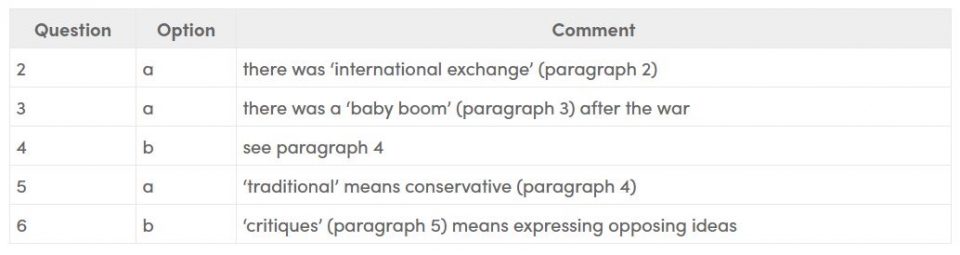
Question 2
a) There was a growth in trading between countries.
b) There was a decline in trading between countries.
Question 3
a) The population increased in the '50s and '60s.
b) The population decreased in the '50s and '60s
Question 4
a) The greatest advances were in entertainment.
b) The greatest advances were in technological developments.
Question 5
a) America was becoming more ideologically traditional.
b) America was becoming more ideologically liberal.
Question 6
a) Everyone approved of the new form of society.
b) People were beginning to be critical of society.
Self-assessment
(A) I got all the answers right and found it easy to do.
(B) I got most of the answers right, but it took me longer than 15 minutes.
(C) I found this difficult and got most of the answers wrong.
If you have assessed yourself as (A), then you are probably ready to study in English. If you have assessed yourself (B), you will probably need support with your English while you study. If you have assessed yourself (C), you may not be ready for study in English.
If you are still not sure go to Try this: Identifying points and expressing ideas.