Drawing a straight-line graph
What do we mean by a straight line graph?
This means, for instance, that if you double one value, the effect is to double the other, and if you third one value, the upshot is that the other is divided by three as well. And the fact that the relationship is directly proportional has an important consequence for the graph-it will necessarily be a straight line.
How do you draw a straight line graph?
Only two points are needed to draw a straight-line graph. Choosing one of the points is straightforward; it is the origin of the graph. If you look at the example graphs below one point of the graph has the coordinates (0, 0).
But this will not always be where the two axes meet. Remember, that not all graphs are drawn with the vertical axis scale starting at zero. This is the same for any distance or length conversion (and others such as area, or weight, or volume).
The other point can be chosen so that it fits conveniently into the range you want the graph to cover. In fact, the further the second point can be placed from the origin the better, because inaccuracies in drawing the graph are reduced.
Look at the first graph below.Here the second point is very close to the origin. Any inaccuracy in plotting this point or in drawing the line through the point will be magnified significantly at the end of the range. As a result, the graph will become less accurate the further you move from the origin. If the second point is put as far away as possible, as in the second graph, any drawing inaccuracy will result in lower errors over the range of the graph.
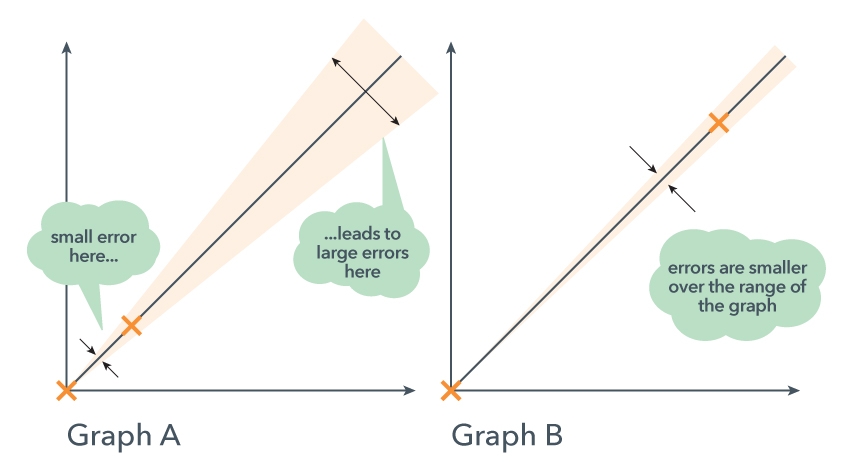
On the example graphs above a straight line links the points and represents the proportional relationship between two variables, for example speed and time, or distance and time.
Now have a look at distance-time graphs to see how graphs can give you useful information.